
Nuclide
Software Development Kit for id Technology (BETA)
ncVideoDisplay Class Reference

About this class

QUAKED ncVideoDisplay (1 0 0) (-8 -8 -8) (8 8 8) Receives a video signal from an receiver and displays it.

KEYS

  • "angles" : Sets the pitch, yaw and roll angles of the surface.
  • "input" : Name of a video input, like an ncAVReceiver

INPUTS

  • "Enable" : Turn the screen on.
  • "Disable" : Turn the screen off.
  • "Toggle" : Toggle the screen on/off.

SPAWNFLAGSS

None yet

TRIVIA

This entity was introduced in Nuclide (2025).
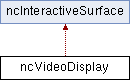
Inheritance diagram for ncVideoDisplay:
ncInteractiveSurface

Public Member Functions

void ncVideoDisplay (void)
 
virtual void SpawnKey (string, string)
 This method handles entity key/value pairs on map load. More...
 
virtual void Spawned (void)
 Called when the entity is fulled initialized. More...
 
virtual void EvaluateEntity (void)
 Run each tic after physics are run to determine if we need to send updates over the network. More...
 
virtual float SendEntity (entity, float)
 Called by the engine whenever we need to send a client an update about this entity. More...
 
virtual void Input (entity, string, string)
 Called when we are being prompted by another object/function with an input message. More...
 
virtual void OnMapFinishedLoading (void)
 Overridable: Called when the level finished loading. More...
 
virtual float predraw (void)
 
virtual void postdraw (void)
 Client: Run after the rendering of 3D world is complete. More...
 
virtual void RenderScene (void)
 
virtual void ReloadVideoResources (void)
 Client: Called when video resources need to be allocated or reloaded for the entity. More...
 
virtual void ReceiveEntity (float, float)
 Client: Handles network updates from the server for the associated entity. More...
 

Constructor & Destructor Documentation

◆ ncVideoDisplay()

void ncVideoDisplay::ncVideoDisplay ( void  )

Member Function Documentation

◆ EvaluateEntity()

void ncVideoDisplay::EvaluateEntity ( void  )
virtual

Run each tic after physics are run to determine if we need to send updates over the network.

Reimplemented from ncInteractiveSurface.

◆ Input()

void ncVideoDisplay::Input ( entity  eAct,
string  strInput,
string  strData 
)
virtual

Called when we are being prompted by another object/function with an input message.

Reimplemented from ncInteractiveSurface.

◆ OnMapFinishedLoading()

void ncVideoDisplay::OnMapFinishedLoading ( void  )
virtual

Overridable: Called when the level finished loading.

Reimplemented from ncEntity.

◆ postdraw()

void ncVideoDisplay::postdraw ( void  )
virtual

Client: Run after the rendering of 3D world is complete.

2D calls can happen here.

Reimplemented from ncInteractiveSurface.

◆ predraw()

float ncVideoDisplay::predraw ( void  )
virtual

Reimplemented from ncInteractiveSurface.

◆ ReceiveEntity()

void ncVideoDisplay::ReceiveEntity ( float  flNew,
float  flChanged 
)
virtual

Client: Handles network updates from the server for the associated entity.

Reimplemented from ncInteractiveSurface.

◆ ReloadVideoResources()

void ncVideoDisplay::ReloadVideoResources ( void  )
virtual

Client: Called when video resources need to be allocated or reloaded for the entity.

Reimplemented from ncInteractiveSurface.

◆ RenderScene()

void ncVideoDisplay::RenderScene ( void  )
virtual

Reimplemented from ncInteractiveSurface.

◆ SendEntity()

float ncVideoDisplay::SendEntity ( entity  ,
float   
)
virtual

Called by the engine whenever we need to send a client an update about this entity.

Reimplemented from ncInteractiveSurface.

◆ Spawned()

void ncVideoDisplay::Spawned ( void  )
virtual

Called when the entity is fulled initialized.

Any spawn key/value info pairs have already been dealt with. So now we can make full decisions on the entity. Always make sure to call super::Spawned(); inside your method when overriding.

Reimplemented from ncInteractiveSurface.

◆ SpawnKey()

void ncVideoDisplay::SpawnKey ( string  keyName,
string  setValue 
)
virtual

This method handles entity key/value pairs on map load.

You can easily convert the strValue parameter using the ReadFloat etc. methods that are part of ncIO.

Reimplemented from ncInteractiveSurface.


The documentation for this class was generated from the following files: